Farmers Guide visit Merlo owner
Andrew recently replaced two ageing machines with a new Merlo TF42.7CS-136, continuing a long-standing relationship with the Italian manufacturer. After a year of use and around 1,000 hours on the clock, the machine has settled into daily farm life, working across a diverse operation that combines livestock, arable cropping and diversification.
Mixed farm with plenty to handle
Andrew farms around 300ha of land, running a varied enterprise that includes beef cattle, sheep and arable crops. The livestock side centres around a suckler herd currently numbering around 50 cows, with plans to expand this to 80–100 head in the coming years. Alongside the cattle, the farm also finishes around 1,500 lambs, which are grazed on grass before being moved onto root crops during the winter months.
Arable production remains an important part of the rotation, with the farm growing wheat, barley and maize, while potatoes – once a much larger part of the business – are gradually being scaled back.
The farm is also diversified with a small industrial business park, providing an additional income stream and reflecting a broader shift towards mixed income sources on many UK farms. Within this busy environment, machinery must be capable of tackling a wide range of tasks – something the telehandler is well suited to.
A long history with telehandlers
Andrew’s experience with telehandlers stretches back several decades. “I remember we had one of the first Manitou machines around here in the early 1980s,” he recalls. “That was brilliant at the time.”
From there, the farm progressed through several brands before eventually settling on Merlo machines, which have since been a regular presence in the yard for many years.
Until recently the farm operated two telehandlers, but as the machines began to age, the decision was made to replace them both with a single new machine and add a front loader to one of the tractors instead.
“We had two Merlos that were getting on a bit,” Andrew explains. “So we sold the two and bought this one.” The farm also trialled other machines before committing to the purchase, but in the end, familiarity and dealer support played a significant role in the decision.
“We’ve dealt with Cooks for years, and they’ve got some good mechanics. That makes a difference,” Andrew commented.
Merlo TF42.7CS-136 tech specs
The machine currently working on the farm is a Merlo TF42.7CS-136, part of the manufacturer’s medium-capacity telehandler range.
With a maximum lift capacity of 4.2t and a lift height of 7m, the model sits squarely in the popular mid-range class for mixed farming operations. The machine is powered by a 3.6-litre 4-cyl Perkins 904 engine, producing 136hp, and uses a hydrostatic transmission driving permanent 4wd.
Key specifications include:
-
Maximum lift capacity – 4,200kg
-
Maximum lift height – 7m
-
Forward reach – 3.8m
-
Unladen weight – Approximately 8,000kg
-
Top road speed – 40kph.
The machine measures 4.73m long and 2.31m wide, keeping it compact enough to manoeuvre around livestock buildings and tight yard areas.
Hydraulic output of up to 250 bar and 150-litres/minute pump ensures adequate flow for attachments, while the machine runs on 400/70-24 tyres and features drop-portal axles. Merlo’s CS specification adds cab suspension and hydropneumatic boom suspension, both designed to improve ride quality during transport and loading work. These are features that Andrew says make a noticeable difference. “The cab suspension helps a lot,” he says. “And the boom suspension makes the ride better as well.”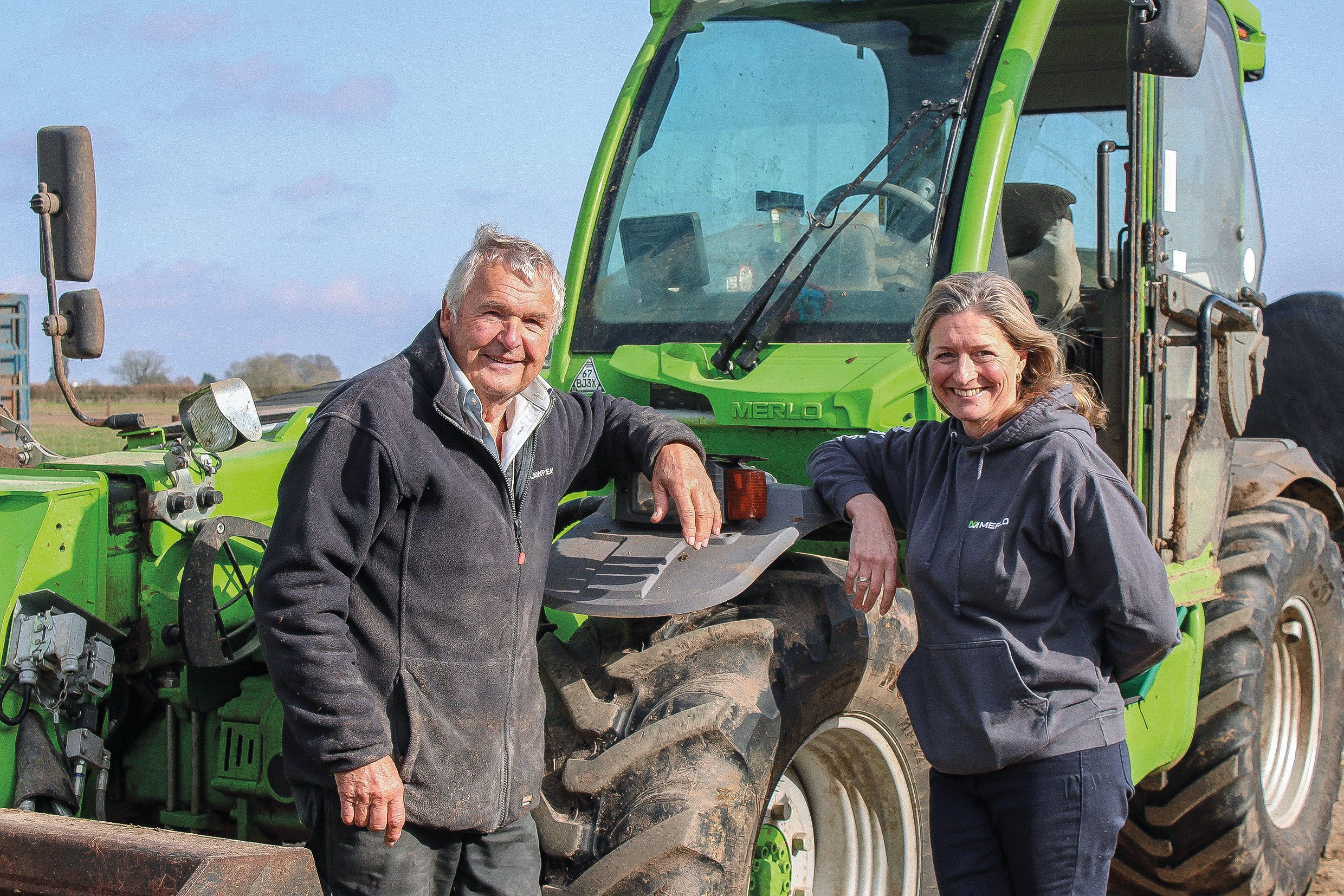
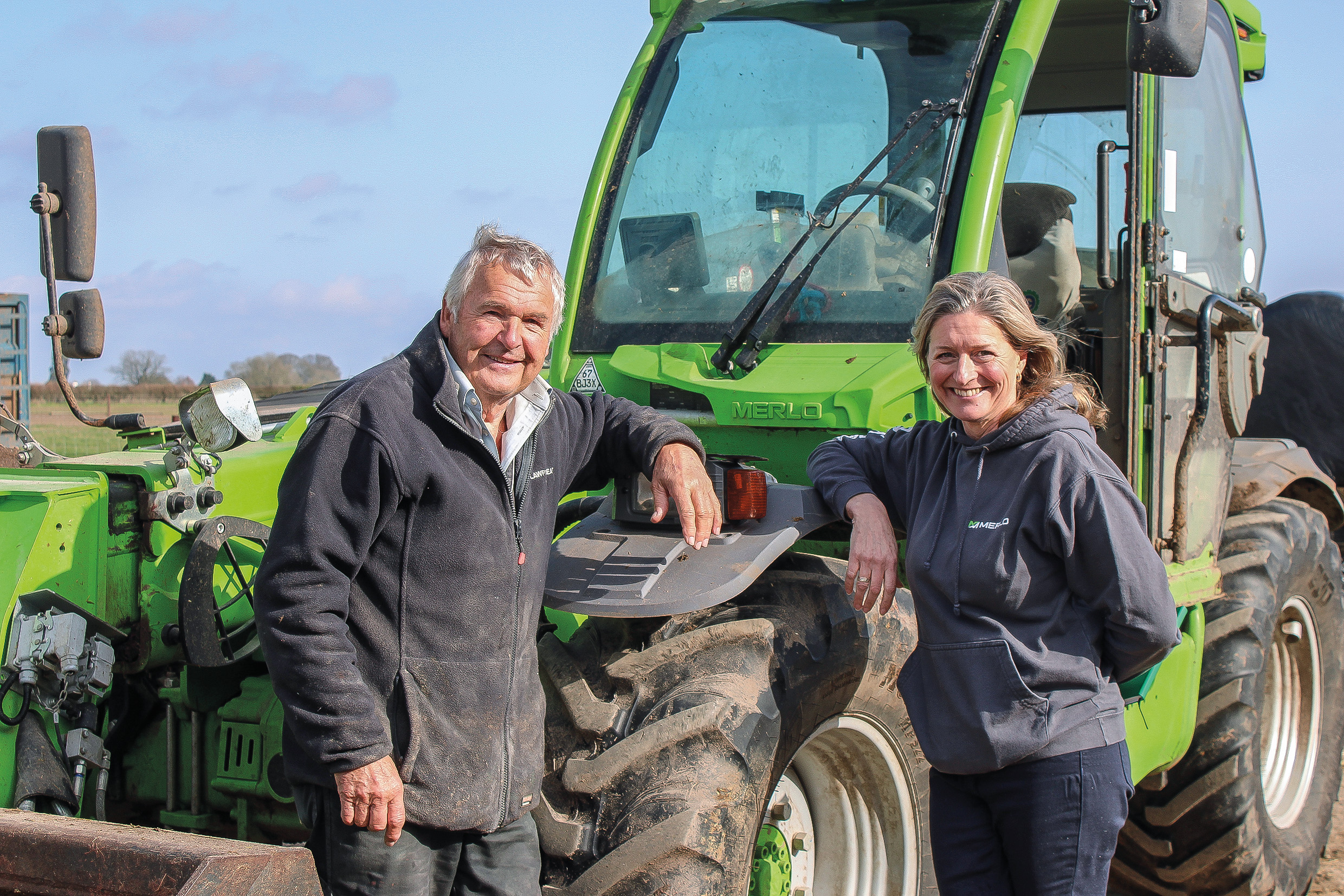
Farmer, Andrew Mitchell with Merlo UK’s Helen Selkin
According to Merlo UK marketing manager Helen Selkin, the TF42.7CS has become one of the company’s most widely used machines in livestock systems.
“It sits right in the middle of the range,” she explains. “For mixed farms, it’s often the model that does everything – yard work, bale handling, loading grain and general farm duties.”
Daily work in the yard
On Andrew’s farm, the telehandler spends most of its time carrying out livestock-related tasks, particularly during the winter months.
“Mainly it’s on the stock,” he says. “Clearing the yards out, putting silage in, putting hay in, and moving bales around.” The machine is also used for loading grain and fertiliser, as well as general yard work. Andrew estimates the telehandler works around 1,000 hours per year, making it one of the most heavily used machines on the farm.
The telehandler is primarily operated by Andrew’s son-in-law, who manages the cattle enterprise. While the farm also runs tractors with loaders, Andrew says the telehandler remains the preferred option for yard work.
“It’s just so much easier around the yard,” he explains. “A tractor loader is fine in the field, but this is far more manoeuvrable and more accurate when you’re working in tight spaces.”
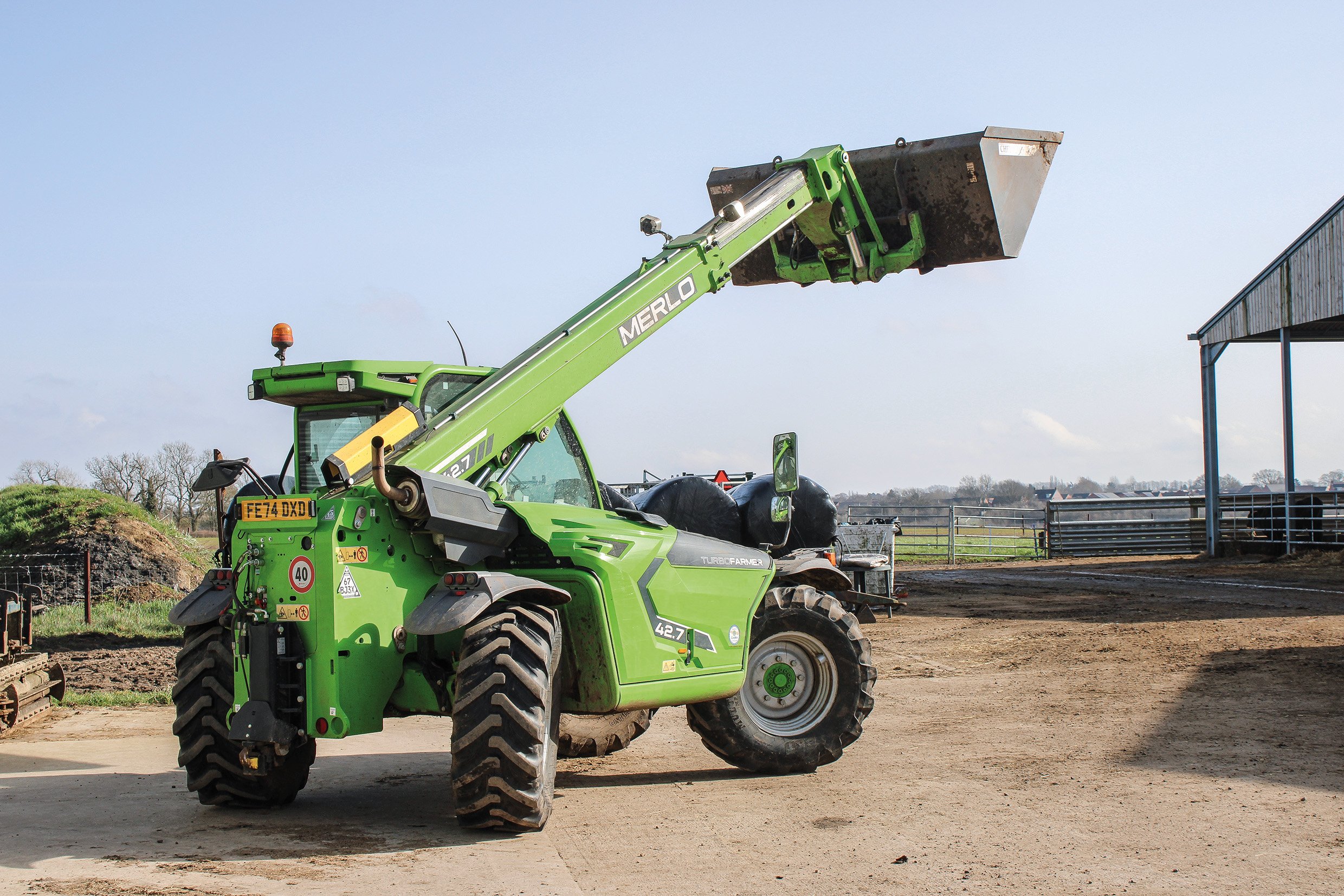
TF42.7: compact enough to manoeuvre in tight yard areas
The farm runs a range of attachments, including several buckets and bale handling equipment. The latest Merlo handler is most regularly used with a large 2.5t bucket, which allows rapid loading of grain and other materials. “You can load a lorry in about 15 minutes now,” Andrew says.
More recently, the farm has added a straw spreader attachment, used for bedding cattle.
Engine performance and traction
The TF42.7CS-136 is powered by a Perkins engine, replacing the Deutz unit used in earlier versions of the machine. While the headline power figures remain broadly comparable, the change reflects wider shifts across the industry in recent years, with manufacturers adapting to supply chain pressures and availability.
In practical terms, Andrew says there is little to separate the machines in everyday use. “We thought it might have a bit more power than the old one, but actually it feels pretty similar,” he says. For the type of work carried out on the farm – largely yard-based livestock duties – outright power is less of a limiting factor than usability and consistency.
After around a year in service, the telehandler has proved well matched to the workload, comfortably handling feeding, mucking out and general handling tasks. The machine’s performance remains consistent across a range of duties, with no significant issues reported during regular operation.
As with most telehandlers, ground conditions can influence performance, particularly during wetter periods. Mitchell notes that sensible operation is key in these situations. “If it’s too wet, we just stay out of it,” he says, adding that overall the machine continues to meet expectations.
Dealer perspective
According to Darren Cook of Cooks Midlands, the Merlo TF42.7CS continues to be one of the dealership’s most popular telehandlers, particularly for mixed farms needing a versatile yard machine.
“Once people drive one and realise how much comfort they get compared with a standard machine, it’s something they tend to stick with,” explains Darren. He says the specification chosen by Andrew reflects the demands of the farm’s workload. “He’s run that size of machine previously and it suits the job he’s doing. It’s got the capacity for the work he needs, and with larger buildings you can make the most of the lift height and visibility. You’re sitting up above the job and you’ve got a good view all the way around the machine.”
From a dealer perspective, Darren Cook believes Merlo’s hydrostatic transmission remains a key reason farmers continue to return to the brand. “The Merlo hydrostatic is a proven system. It’s reliable, precise to drive and easy for operators to use,” he says.
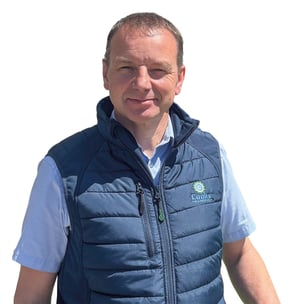
Darren Cook, Managing Director Cooks Midlands
“I always say to customers that with a hydrostatic machine you feel like you’re in control of it – rather than the machine being in control of you.” He adds that strong dealer support also plays an important role in building long-term relationships with customers.
“A lot of it comes down to service backup, and making sure we have the knowledge and skills to support the machines properly.”
 Reproduced by kind permission of Farmers Guide
If you've enjoyed reading this post, please share to your social media.