Relied on Merlo for Three Decades
At West Scoutts Farm near Tarbolton in Ayrshire, the telehandler rarely sits still.
From early-morning loading of diet feeders to bedding calf pens, it runs from start to finish each day.
For farmer Alistair Hodge, that daily workload is why the farm has relied on Merlo telehandlers for over three decades.
West Scoutts Farm has been owned by the Hodge family since 1991, when it was purchased by Alistair’s family, in addition to Home Farm near Mauchline.
He and his wife Sandra later moved to West Scoutts in 1996.
.jpg?width=642&height=641&name=special%20edition%20TF33%20(1).jpg)
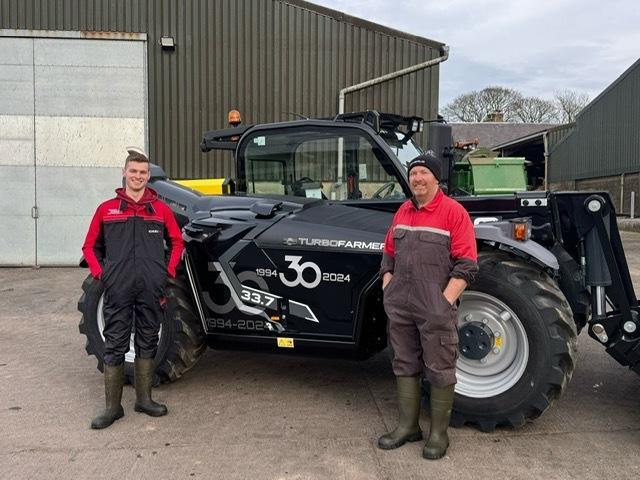
This special-edition TF33.7-115 stands out in a striking black paint finish (image: Ramsay & Jackson)
Today the unit covers around 425 acres, with roughly 340 owned and 85 rented, and centres on a dairy enterprise running about 650 head of Holstein Friesian cattle including milkers and replacements.
The business is still very much a family operation. Day-to-day work on the farm involves Alistair, his son Craig, Sandra, one full-time employee and some part-time help when needed.
“It wasn’t a dairy farm when we came here, we’ve just built things up over time,” said Alistair.
With livestock numbers at this scale, efficient materials handling is essential. The telehandler feeds cattle, beds pens, moves straw and bales, and carries out general yard work.
The farm has also had success in crop competitions, recently winning the maize section at the South West Scotland Grassland Society competition with an analysis of DM 24.50, ME 12.42, p8.9, starch 28.2.
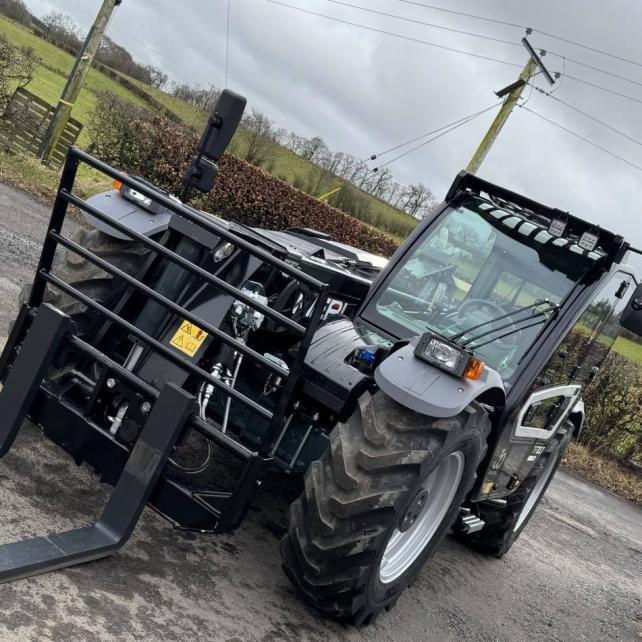
The TF33.7-115 offers 3.3t lift capacity and 6.6m reach (Image: Ramsay & Jackson)
“Some days you could be filling up to six wagons,” he explained.
“That’s where the handler really earns its keep.”
Attachments include bucket, shear grab, pallet forks, and bale lifter, giving flexibility for silage, straw or loose materials.
The right size for the job
Even as the farm has grown, manoeuvrability remains crucial. While West Scoutts doesn’t have particularly narrow buildings, the ability to move quickly around livestock areas and yards makes a real difference.
“The manoeuvrability is key. You want something that can get about easily but still has enough reach for filling wagons or stacking.”
Neil Ramsay of Ramsay & Jackson, Mauchline, noted: “The TF33.7 sits right in the sweet spot for a lot of farms.
“Along with a couple of other models in the compact range, including the P27.6 and TF30.7, it’s consistently among our top three selling sizes because it suits so many livestock yards.”.jpg?width=642&height=641&name=special%20edition%20TF33%20(2).jpg)
Standard 400/70-20" tyres offer grip and stability in yards (Image: Ramsay & Jackson)
The Hodge family’s connection with Merlo goes back to 1994, when Ramsay & Jackson began supplying the Italian-built handlers. At the time, the dealership was just getting its telehandler franchise off the ground.
“Neil actually came to see us when they first started selling Merlo,” Alistair recalled. “That was when we bought our first Merlo.”
That first machine was a Merlo P27.7, one of the early panoramic models designed to give operators much better visibility than previous loaders. Built in the mid-1990s, it weighed around 6.15t and offered a 2.7t lift capacity, with a maximum lift height of about 6.7m, and roughly 1.1t capacity at full forward reach.
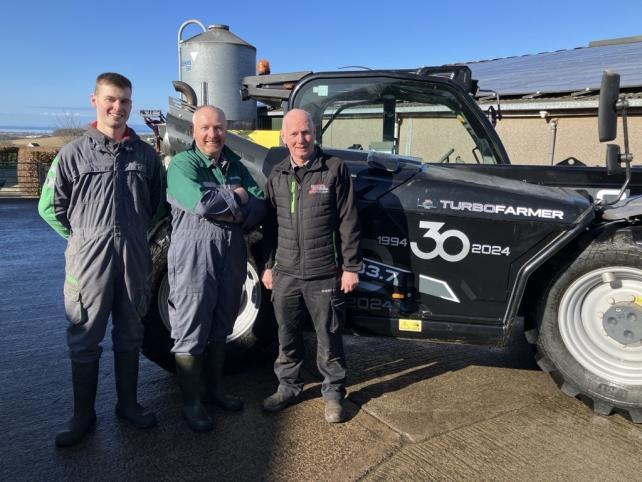
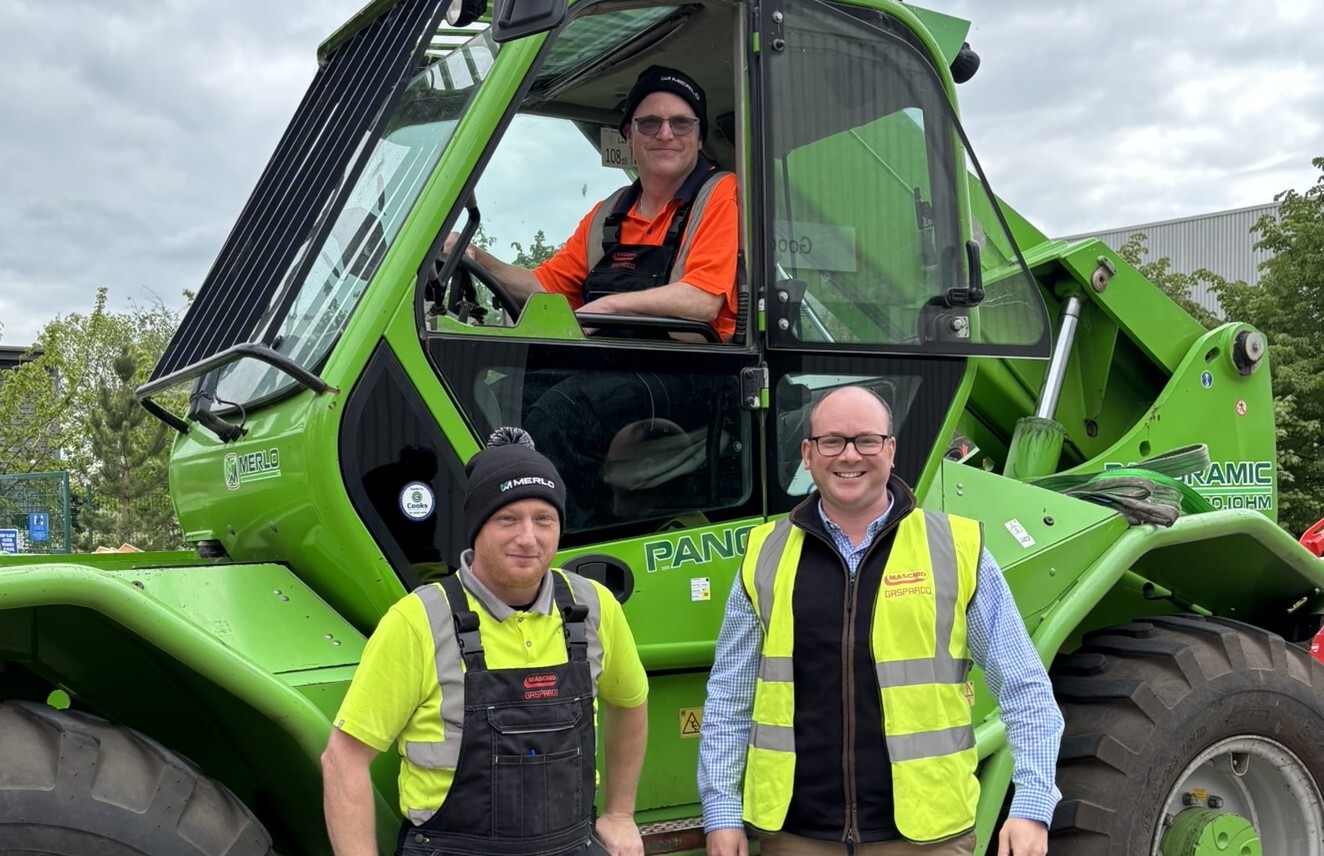
Alistair (centre), his son Craig, and Neil Ramsay with the TF33.7-115 at West Scoutts Farm (Image: Ramsay & Jackson)
Since then the farm has continued running Merlo machines, upgrading as hours build.
Prior to 2017, the Hodges’ machines were typically models P34.7 or P32.6. Since then, they have stuck with the TF33.7‑115, with three or four units of this model supplied.
The current handler has already recorded around 1800 hours in the year since it was purchased.
Dealer backup has been key to maintaining that loyalty.
Alistair added: “If anything breaks down, they’re straight out. They’ll even bring a replacement machine if needed, so you’re never left stranded during busy times. It works both ways - you build a proper relationship.”
The farm also sources most of its other machinery through the dealership, from tractors to feeder wagons.
Telehandlers have changed a lot since the 1990s, but Alistair says the basics remain the same.
“The fundamentals are still there - hydrostatic drive and good visibility - but everything has improved over time.”
.jpg?width=640&height=480&name=special%20edition%20TF33%20(3).jpg)
The black Merlo TF33.7-115 - available in any non-metallic RAL paint colour at extra cost
(Image: Ramsay & Jackson)
The latest machine
The latest addition is a Merlo TF33.7-115, part of the compact Turbofarmer range. It offers 3.3t lift capacity and 6.6m reach, powered by a 115hp Deutz diesel engine.
“It’s a good size machine for what we do. Manoeuvrable enough for the yard, but still with the lift and reach when you need it.”
The previous machine was a TF32.6, which had served the farm reliably for several years.
“We tend to change before things get too old because it does so many hours” he explained.
The hydrostatic transmission is one feature he particularly values.
“You more or less just drive it with the accelerator. When you take your foot off, it stops. Very easy to use, simple for anyone getting into it.”
Attachments can be swapped quickly thanks to Merlo’s Tac-Lock system, letting operators change between bucket, grab, or bale tools straight from the cab
“That saves a lot of time when you’re doing different jobs through the day.”
For West Scoutts, upgrading regularly comes down to reliability.
With the telehandler doing so much of the farm’s daily work, downtime simply isn’t an option.
“It’s the machine that does the most work here, so you want to keep it dependable.”
Regular upgrades ensure the farm always has a capable and reliable handler available.
While machinery technology may continue to develop, including alternative fuels and electrification, the need for practical, versatile yard machines isn’t going away.
For farms like West Scoutts, compact telehandlers will continue to play a vital role
 Reproduced by kind permission of the Scottish Farmer
If you've enjoyed reading this post, please share it to your social media.